Beware the Dragonriders of BURN!
Previously on Avatar: three years ago James Cameron did his part to help save beleaguered theaters worldwide after the pandemic with the billion-dollar spectacle Avatar: The Way of Water, the long-awaited sequel to the 2009 blockbuster. At the time I boiled down my impressions:
The predictably huge box-office smash is the visually stunning James Cameron comeback we expected, an underwater world of wonder that left our IMAX 3-D audience stunned all throughout its three-hour runtime. The beautifully panoramic Pandora ocean-tribe expansion pack and the extended no-holds-barred final-battle extravaganza exceed the baselines even by Cameron standards in all their gloriously maximized CGI razzle-dazzle nonpareil…[but] after exiting the theater and regaining your senses it’s much easier to think again, and disappointing to realize you’ve just watched the most expensive witness-protection story in world history, one in which Our Hero sought to stop endangering his community by moving his family to a strange new neighborhood and endangering them instead. And much of the family’s stresses feel like Cameron reusing salvaged parts from his previous films and from any number of fish-out-of-water family dramas. The technological bells-‘n’-whistles have been upgraded in accelerated leaps and bounds, but the chassis could use some new solder and an oil can.
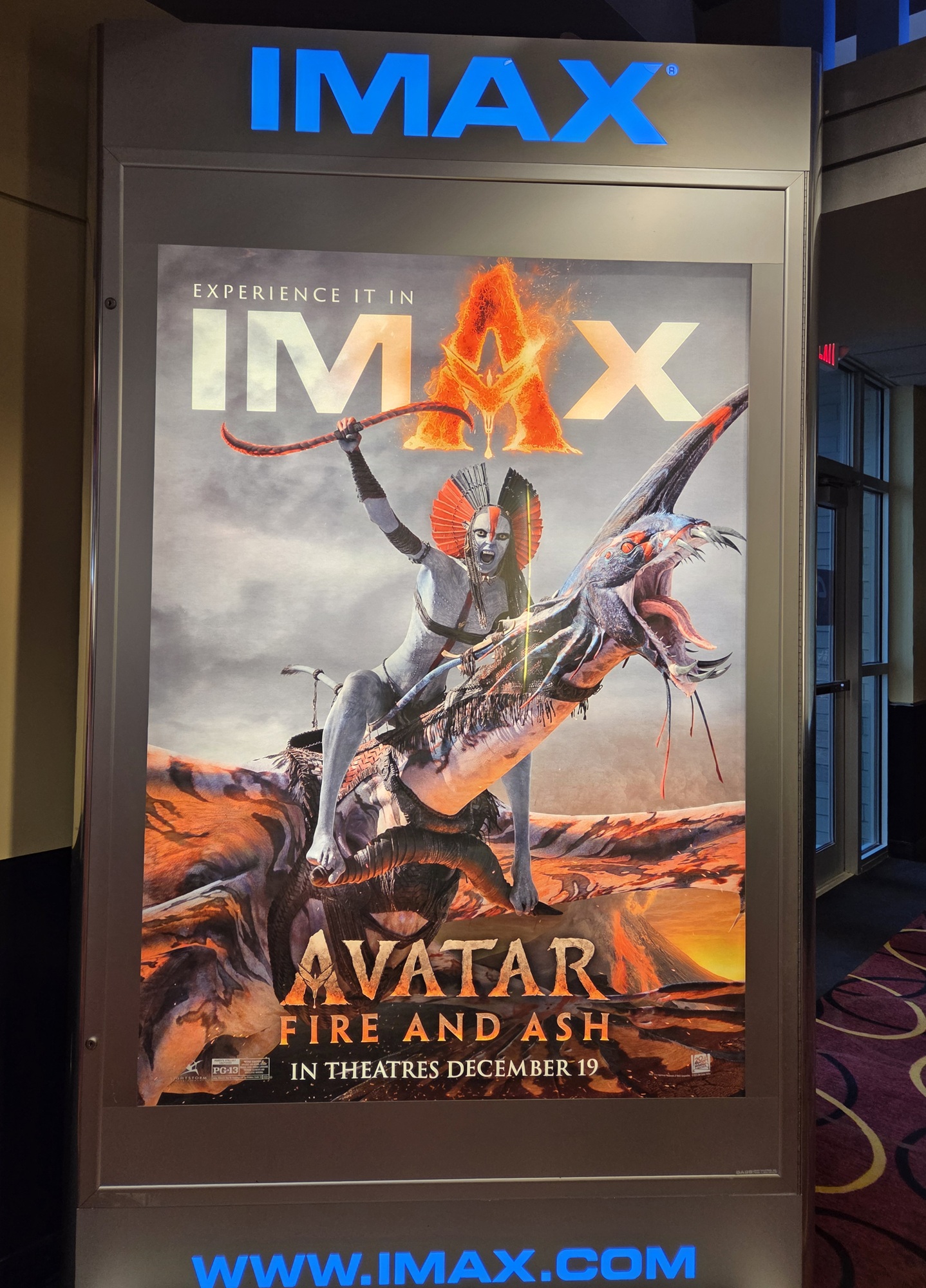
But oil and water don’t mix, and some guys love laying amazing paint jobs over refurbished parts, so here we go again. Cameron and the same four co-writers continue the saga with Avatar: Fire and Ash, which is here to re-rescue the box office through the healing power of space magic and environmentally friendly EXPLOSIONS!
Part 3 in the series seems more character-driven than plot-driven in its better moments, if only by default because the story boils down to thin algae traces. Sam Worthington’s former human soldier Jake Sully is still a Na’vi head-of-household trying to keep his family safe, which once again goes poorly because his choices are almost always terrible. Their latest chartered trip across planet Pandora goes awry when their ships and flying space dragons are accosted by a new tribe called the Mangkwan. These rebels have turned their backs on Eywa, Pandora’s answer to Mother Nature, because she didn’t save them from disaster this one time and a lot of them died, so now they’re anti-religious bandits. Their mad-on for the Na’vi mainstream aligns with the imperious motives of Earth’s invading military, who are still a threat that hasn’t been quashed, kinda like how G.I. Joe never, ever defeated Cobra and wasted countless taxpayer dollars that no amount of action figure sales could ever recoup.
All those greedy Earthmen who survived the first two films are still bent on conquering and colonizing Pandora despite the unbreathable atmosphere, and forge an alliance with the Mangkwan, who just want to watch the world burn. With the two enemy forces united against Our Heroes, naturally A War is Coming. Yes, AGAIN. Yes, same as the first two, but instead of The Way of Water‘s sci-fi recreation of the sinking of the Titanic, this time the centerpiece of the feature-length Final Battle is an old-fashioned Pillar of Light, this one made of swirling magnetic fields that wreck anything they suck in. Considering the Na’vi don’t use much metal, you’d think the good guys could win simply by shoving all those heavy-metal starships and exoskeletons toward the Pillar of Light and letting it finish the job, but audiences don’t shell out top dollar to see heroes just nudging their way to victory.
Each character takes turns living their own arcs within that straightforward framework, most of which Jake keeps making worse as everyone’s still grieving the death of his son Neteyam (Jamie Flatters) at the end of the second film. Zoe Saldana, whose career status can beat up Wortington’s, gets more screen time and more archery action as grieving warrior-mom Neytiri. Sigourney Weaver is still their teen daughter Kiri, the space reincarnation of the human scientist she played in the first one, whose strange connection to Eywa might yield superpowers if she can figure it out, but it’s hard for her to concentrate when the family and the film won’t hold still. Her other brother Lo’ak (Britain Dalton) is crushed by survivor’s guilt and struggles to make Neteyam’s sacrifice count for something. Youngest sister Tuk (Trinity Bliss, who’s since been in The Life of Chuck) is alternately a liability, a cheerleader, and a hostage as plot needs dictate.
And then there’s Spider. Character moments are usually among Cameron’s firmest non-computer-related strengths, but much of Fire and Ash rests on the assumption that everyone loves Spider, the Sullies’ Kamandi-esque adopted human son. He’s plucky and well-meaning in the face of adversity, but lacks Na’vi resilience, height, lungs, dazzling VFX skin palette, and plug-‘n’-play creature-control neck-tails. He’s cursed with the dialogue of a ’90s teen skateboarder, shielded in the thickest plot armor Cameron could construct, and somehow in the family’s many running scenes he and his tiny human legs are always in first place. Jack Champion was mostly harmless in Scream VI, but his scenes as Spider were filmed years earlier and feel coddled every step of the way. Much of the film’s first half is devoted to magically solving some of his innate deficiencies, but power upgrades aren’t enough to ameliorate his Cousin Oliver complex. He’s the most irritating Chosen One since Anakin Skywalker.
Meanwhile on the side of warmongering, Stephen Lang is yet again magnificently brutal as Colonel Quaritch, the Na’vi-bodied digital reincarnation of his human self who died so memorably and satisfyingly at the end of the first one. That human self was also Spider’s real father, so the current Quaritch suffers conflicts of interest as he continues following orders from his military Earthling overlords, still lusts for revenge against Jake, and intermittently thinks about reaching out to his abandoned son. Much of the drama in between EXPLOSIONS rests on the deadbeat-dad disconnection between Spider and Quaritch. Lang holds up his end to the extent that he can penetrate Spider’s plot armor, but they aren’t exactly Vader and Luke.
As a consolation prize, Quaritch also makes himself a new special friend. Oona Chaplin (Game of Thrones, FX’s Taboo) is the series’ best new face as Varang, fiery matriarch of the Mangkwan raiders — a shrewd, limber, ceaselessly furious tyrant who’ll massacre anyone standing in the way of her surviving followers. At first Quaritch negotiates with her like any would-be enemy occupier trying to establish diplomatic ties with the enemy of their enemy (100 points for every real-world parallel you can brainstorm!), but before long their shared love of self-serving cruelty sparks a rather twisted space romance that’s consummated in a hallucinatory sex-fueled drug trip that’s one of the film’s most visually inventive scenes, absolutely unlike anything in the first two films, while remaining as chaste as a TV soap opera.
And really, aren’t those effects the reason we all came in the first place? I wrote about The Way of Water:
On a technical level, “Way of Water” is an impeccable visual masterpiece in IMAX 3-D. Part of me wonders if the film loses some hypnotic power in 2-D, and whether that explains why some critics were harsher than others. For my format choice the alien ocean scenery was beautiful, the details on the various organisms and humanoids were fascinating to scrutinize whenever they slowed down long enough for me to focus my eyes through the second pair of glasses, and the machinery of course met the director’s standards — and then some — set by all his past military-SF milieus.Without computer facelifts, our real world already looks magnificent up close. Cameron created Pandora as a Mary Sue of Earth itself, a hyperreal elaboration on life as we know it — everything shines, bioluminescence is everywhere, and all organisms are interconnected. On Pandora, if you mess with one aspect of nature, you mess with all of nature, and you’ll ooh and ahh in wonder as its enforcers wreak vengeance upon your face. Who’d want to be cruel to a world where beauty and teamwork are equally inherent in the ecosphere?
That nonstop action blockbuster finale proves Cameron still has the old sensibilities, the reflexes, the showmanship, and the master architect’s eye and ear for constructing the perfect thrill ride. Granted, a lot of it recycles used parts from all his other films, but leave it to the environmentalist to put recycling to maximum use. In IMAX 3-D that last hour flies by as everyone and everything is catapulted headlong from one skirmish to the next, the survivors keep tripping over new obstacles, all those space whalers get blown up real good, Quaritch gets tons of action screen-time, Weaver finds ways to contribute to the battle without reprising Ellen Ripley in any way whatsoever, the parents’ ostensible sacrifices to save the kids eventually inspire the kids to step up and use their own talents and connections to return the favor, and the emotional beats can hit you up for a few earned tears.
…all of which still holds true. I’m not retyping all that. Granted, most of the digital splendor in this chapter isn’t remarkably different from that one, in terms of offering new sights. Also, I felt fewer tears this time around, though one scene involving a despondent character facing suicidal thoughts is an overwhelming gut-punch that’s so, so much heavier than the rest of the film surrounding it. On the opposite end, a contrived Abraham-and-Isaac moment comes practically out of nowhere and doesn’t earn the reaction Cameron strains to evoke. (Jaded viewers may in fact root for the opposite outcome and cue up the Willy Wonka “stop, don’t” meme.) Kaiju fans might dig a convening of Pandora’s resident Parliament of Space Whales if they can indulge its intent as a maritime courtroom drama.
One new development for me in this series, which isn’t necessarily a filmmaking fault: Fire and Ash left me reeling from intense motion sickness. I had the same problem earlier this year with the Oscar-winning documentary No Other Land, an understandably shaky-cam project that’s the opposite of Avatar on nearly every conceivable level (save a shared longing for world peace among disparate factions). Maybe it’s my fault for selecting sixth-row IMAX seats, but those first 60-90 minutes were really rough going till my autonomic systems somehow adapted and settled down for the second half. I usually bring Dramamine whenever I expect turbulence in my leisure (e.g., our occasional forays to amusement parks, or that one time we were on a boat for more than ten minutes), but I hadn’t expected to encounter that. So, fair warning to physically sensitive viewers out there.
For any viewers never harmed by roller coasters, the Avatar: Fire and Ash thrill-ride spectacle is quite the achievement as long as you don’t sweat all the non-visual components. Then again, much as Netflix and other streamers have realized in recent times with their increasingly more pedestrian dramas, Cameron knows convoluted, avant-garde films rarely earn a billion dollars worldwide. He keeps the thinking parts simple, leaning into time-honored Morals of the Story such as “Planet and nature good, greedy humans bad” and “You don’t turn your back on family.” And he makes it all extremely pretty. It’s merely a bonus that he also casually invents new forms of cinematic technology along the way that’ll revolutionize the medium for years to come if any other filmmakers are smart enough to follow his epic-length instruction manuals. Cameron’s got a system and it works for him, setting aside his blind spot for the itsy-bitsy Spider that keeps climbing up his waterspout.
…
Meanwhile in the customary MCC film breakdowns:
Hey, look, it’s that one actor!: Given that almost no other named characters died in The Way of Water, nearly its entire cast returns. Welcome back Academy Award Winner Kate Winslet and Cliff Curtis as Tonowari and Ronal, the heads of the Metkayina tribe who’re still hosting the Sullies amongst their waterborne community; Joel David Moore and Dileep Rao as our happy helper scientists; and CCH Pounder as Neytiri’s mom. Over on Team Greed, The Sopranos‘ Edie Falco is still Quaritch’s commanding officer, who’s struggling to keep him in line; Giovanni Ribisi’s skeevy corporate overlord has a little more screen time; Matt Geralt (Daredevil, G.I. Joe: Retaliation) is Quaritch’s lead henchman; Jemaine Clement is still a complicit scientist, but not so compliant anymore; and Brendan Cowell (Dune: Prophecy) survives as the head whaler, minus the arm he lost last time.
The only other prominent newcomer is David Thewlis (Harry Potter, Wonder Woman) as a traveling Na’vi merchant.
How about those end credits? No, there’s no scene after the Avatar: Fire and Ash end credits, but in light of the aforementioned scene involving possible suicide, for any audience members who might be struggling with harmful thoughts and who happen to stick around long enough to read the entire cast list, after that comes a message to them and a number they can contact for help. If they leave immediately as the credits start, they’ll miss the attempted outreach. If you’re aware someone in your party might need a kind word, do whatever you can to stall for time till the credits get to it, I guess?
“No Other Land”: The Oscar Nominee THEY Didn’t Want You to See

Now playing in 54 theaters this weekend, as opposed to Captain America 4‘s 4,100+ screens.
Previously on Midlife Crisis Crossover: Oscar Quest ’25 continues! Once again we see how many among the latest wave of Academy Award nominees I can catch before the big ABC ceremony, assuming the filmmakers can afford a release wide enough to reach us Midwest film fans in time.
As of February 17th my Oscar Quest scorecard was down to the final five unseen works, all of which I’d assumed would remain out of my grasp for the rest of the season. Then up stepped Indy’s own Kan-Kan Cinema, an eclectic nonprofit who frequently hosts tiny new films that the major chains overlook or think aren’t worth their time and space, because they really really need a dozen screens showing Dog Man for the rest of the year. Of all our theaters, I should’ve known they’d be the first (and as of this weekend the only one) to jump at the chance to bring us No Other Land. In a true rarity for recent Oscar history, it was nominated for Best Documentary Feature without a preexisting distribution deal. The filmmakers themselves have had to foot the bills for a slow rollout because all the studios passed on it (major and minor), possibly because it contains that magic hot-button word guaranteed to start a riot whenever it’s dropped into a conversation among two or more people: “Palestine”.
The self-release difference is noticeable from the first frame: a single film festival’s static logo and the production company’s typed name (sans animation) are all we get before the film proper begins…as opposed to other films today that can begin with at least three or four other studios, distributors, or exec producers’ vanity cards. (Most annoying collection of credit-hogs this Oscar season: the otherwise exemplary animated feature Flow takes a full 105 seconds to list all the entities that insisted on their names above the title. I’m glad so many people wanted to help make that one happen, but after the first five or six logos it started to feel like an SNL sketch mocking the practice.)
[Before proceeding, allow me a preemptive disclaimer: this topic is not among my areas of expertise, to put it extremely mildly as a confessed ignoramus in the political sciences. If you’re interested in such debates or in nitpicking any relevant semantics, there’re six hundred million internet users out there on any given side who’d love to exchange screaming fits with you. I am not among them.]
Anyway: rather than attempt a complete history of Israeli v. Palestine and all possible perspectives on the conflict of seemingly infinite duration, the heart of No Other Land is a personal story of Masafer Yatta, an area in the southern West Bank comprising some nineteen villages, maybe give or take a few at the time the narrative joins events in progress. Local former law student Basel Adra was raised in the digital age with the nurtured reflex to be prepared to video any and everything around him of interest. After sharing a few old home movies, he foreshadows the calamities coming to his homeland: “I started filming when we started to end.”
As the film tells it, the residents of Masafer Yatta fought a 22-year legal battle to justify their settlements in that very location, with records thereof dating back to at least the mid-19th century, well before the Israeli occupation in 1967. (At one point I’m pretty sure someone cites a happening in 1830.) Circa 2019 the Israeli government in the Israeli courts, planning to turn that portion of the Israeli-occupied territories into Israeli military training grounds, rules in favor of Israeli interests and responds to the Palestinians’ passionate defense with [checks notes] “Nuh-uh.”
Thus are Masafer Yatta’s population ordered to commence evacuation so tanks could roll in for target practice or oil change lessons or whatever. But the villagers would not go gently into that good night. They’d lived there all their lives and feel they have every right to stay put and keep living as if nothing new had happened. Amid this fraught prelude, Basel befriends an Israeli journalist named Yuval Abraham who considers his government’s actions “a crime” and embeds with Basel’s family and neighbors, hoping to shed light on the situation back home despite the low clicks such stories supposedly netted at the time. I imagine his traffic has had its upswings since then.
(Basel and Yuval are two of the film’s four credited writers, directors and editors. Of the other two, Rachel Szor held the most cameras and gets the cinematography credit, and Hamdan Ballal is a photographer and researcher from Hebdon. The total activist filmmaker count: two Israeli, two Palestinian.)
Hometown pride sustains and emboldens the villagers as we meet a few of them. Then one day come the soldiers to begin clearing everyone and everything out, with construction crews set to demolish every structure in sight. Masafer Yatta covers nearly fourteen square miles, so it’s a slow process over the next few years — a few homes here, a few blocks there. Some retreat to nearby caves, while the more resourceful and tenacious knuckle down and begin rebuilding. Each time the soldiers return to continue the pulverizing, they confiscate their tools, requisition their cars, disperse their many organized protests, and deny all vain attempts at obtaining rebuilding permits. Far as Israel is concerned, negotiation is no longer an option and they “need” all that prime space for their warring exercises, as if devastated wastelands were in short supply ’round those parts.
Whatever one’s opinions might be on any of this, the basic premise of No Other Land is we’re helplessly watching the heart-rending process of good people losing their homes, possessions, infrastructure, communities, everything they know. Appliances and bathrooms and collections are crushed. Children boggle in wonder and fear as a line of armed, uniformed gunmen march toward their school, which is later torn to rubble by an uncaring backhoe. A cement mixer dumps its load down one village’s well while henchmen saw through the connected pipes. Some Palestinians are chased and even attacked on camera, including Basel himself more than once, as well as another townsman who’s shot and left paralyzed from the shoulders down. Some farm animals absolutely are harmed in the making of this film. And so it goes.
As events unfold through the various cameras and phones, I experienced something I haven’t felt at a film in years: motion sickness. Our screening was packed and possibly even sold out, with seemingly only one empty seat left at showtime, right next to me in the third row. (I tried not to be offended by the late-arriving gentleman who watched the film standing up in the entrance hall rather than sit next to me.) Mine was a pretty choice seat until the confrontations escalates with the encroaching soldiers, everything grows increasingly frantic with all the necessary fleeing to safety, and all that understandable, potentially vertigo-inducing shakiness keeps going for long takes. If I’d known, I’d’ve taken a Dramamine in advance, same as I used to do for amusement park trips. As it was, I had to drive with the windows down the whole way home until the nausea passed.
To Western audiences with stronger stomachs than mine, at times it’s awfully reminiscent of all those movies and TV shows we’ve been raised on, where real estate magnates evict goodly tenants out of the old tenements or longstanding city blocks they’ve just bought up so they can get filthy-richer gentrifying them into more profitable upscale districts. Or hey, remember that time Judge Doom wanted to pave over Toontown with an all-new freeway? Or that time the Vogons destroyed Earth to make way for a new hyperspace bypass, only that turned out to be a lie? (During the text epilogue, one sentence implies the Israelis might actually have taken a page out of the Vogon playbook.)
Keep in mind, all of the above occurred and was shot prior to October 7, 2023, which is yet another date on the calendar we’ve lost to modern-day infamy along with 9/11, January 6th, and May the Fourth. Neither Hamas nor October 7th are mentioned at all until a short coda fast-forwards to the week after that date. One last bit of footage — Basel’s final, personal recording in Masafer Yatta — ranks among the ugliest moments shown to us. The next sixteen months’ history-in-progress are beyond the scope of this particular document.
Obviously there’re detractors who’ll never see the film (not even for their own Oscar Quests!), or have a litany of “well actually” rebuttals prepped for sharing at the drop of a mention. If anyone in Masafer Yatta were criminals, terrorists, rampaging invaders, or so much as slightly rude to restaurant waitstaff, none of that is portrayed here. If your stance is that such absences are irrelevant because all Palestinians are trespassers without rights just on instant principle, and if you are all about rendering your judgments of entire peoples in broad generalizations, then you and No Other Land will not be friends. It probably isn’t playing in your city anyway. I hear Dog Man has some cute parts, though.
…
Meanwhile in the customary MCC film breakdowns:
Hey, look, it’s that one actor!: Among numerous news clips spliced in among the verité, one features former UK Prime Minister Tony Blair taking a seven-mile walk through Masafer Yatta to tour the wreckage and some of the remaining homes. We’re told some demolition orders were subsequently rescinded for a while, long enough to make England feel a difference was made by this light intervention. ‘Twas only a temporary reprieve, judging by how the film does not end immediately with that report.
How about those end credits? No, there’s no scene after the No Other Land end credits, which are quite short and conclude with a list of the grants and funds that made the film possible despite seemingly zero support from Hollywood.
Out in the lobby afterward, representatives from the Indiana chapter of Jewish Voice for Peace had a table set up and were giving out free pamphlets, buttons, and info for those who want to learn more from their perspective.